
General tips
We’ve found that media coverage of the Etsy Strike was staggeringly positive – even with media that we were expecting to be negative, or neutral at best. It makes sense – “giant corporation screws over a bunch of artists in the name of profit” is a good story. That it’s also the honest-to-goodness truth, and we have the data to back it up, helps!
Our biggest advice is, don’t be nervous. The reporter will be good at their job, and their job includes helping you by asking questions in a way that feels like a conversation, and puts you at ease.
Anonymity
If you wish to remain anonymous, that’s ok! Every journalist we’ve talked to has been fine speaking with sellers who wish to remain anonymous. They will usually use the initial from your first name and a short description of your shop.
Questions to Expect
Below is a list of general questions we’ve seen in past interviews. You likely won’t get them all, and there’s a chance that you could get a question not on the list. Read through them, and think of what you might like to say for each.
- How long have you had an Etsy shop?
- What do you make/sell?
- How do you feel about selling on Etsy in general?
- How was Etsy in the past?
- How has it changed?
- Do you use other platforms besides Etsy?
- Is Etsy a full time job for you?
- Is there anything else you would like to say that I haven’t asked you?
Then you will be asked questions about the specific issue you are talking to the media about. Usually these questions are about your experience and perspective on that issue. For example, during the strike sparked by the fee increase common questions were:
- How has the fee increase affected you financially?
- What things besides the fee increase are important to you to change?
If you answer one of these questions in a unique way (we are all quite unique, as Etsy Sellers!) expect a followup question for more information – just like would happen in a conversation.
We also expect you will get questions about the Guild, these are some examples that we think you might get asked. Remember, you are not on the hook to know everything about the Guild. You are a member and we hope you will share your personal experience, but you are not an official spokesperson of the ISG and do not have to answer nitty gritty questions about how the Guild works. If you get a question you don’t feel comfortable answering, you can let the reporter know they can contact us at [email protected] or take a look at the Guild FAQ.
- Why did you join the Indie Sellers Guild?
- Why do you think sellers need an organization like the Guild?
- When did you join?
- Who can be a member of the Indie Sellers Guild?
- What issues with Etsy are you hoping the Indie Sellers Guild can address?
- What are you hoping to get out of being a member of the Indie Sellers Guild?
About the Indie Sellers Guild
- The Indie Sellers Guild is a registered nonprofit.
- Membership is free.
- The ISG is an all-volunteer organization.
- We’re international – we welcome indie sellers all over the world.
- Membership is open to sellers of:
- Handmade items – made or designed by the seller (or both!)
- Vintage items
- Craft supplies
- Our seller membership criteria matches that of Etsy, but you don’t have to sell on Etsy to join.
- A team of volunteers verifies every ISG member.
- It’s a democratic organization – every seller member gets a vote, and anyone can get involved.
- Friends, supporters and customers can sign up as ally members.
More information about the guild can be found in our FAQ.
Individually, Etsy sellers have no power. One person high up at Etsy can make a decision that affects millions of shops – millions of people’s ability to make a living.
Together, we can make a difference. We can put pressure on Etsy to change policies that hurt creators and small businesses, when tens of thousands of us speak out, all at once.
We aren’t anti-Etsy. We are fighting to save the Etsy that everyone knows and loves – where one human being can go to shop from another human being, and find something that wouldn’t exist on a different platform.
Below are the demands from the 2022 Etsy Strike and their talking points.
Feel free to use this as an example of how to talk about issue facing sellers or demands to Etsy. For the Guild’s stance on recent issues, our blog is the best resource.
Why we are organizing
In this section, you’ll find a tab for each of our demands, with tips on discussing them in ways that are understandable to people who have never used Etsy before. It’s a complicated platform!
We chose these demands during the Etsy strike when we were just a group of sellers on Reddit. Now that we have grown into the Indie Sellers Guild, we continue the fight together with our thousands of members.
In the beginning, our original 150-seller focus group listed every issue we could think of, then narrowed it down to 5 things that the majority of us found most important to fight for. Not all of them are important to all of us, however! Every Etsy business is different.
If a reporter asks about a demand that you don’t connect with, you can say something like:
“That’s really important to other people in our movement, but for my business, that’s less of an issue. What’s more important to me is (your demand).”
The reporter won’t mind you pivoting to talk about something you are more passionate about. It will make the interview more interesting to the people that watch, if you’re more engaged in the conversation, and at the end of the day, that’s what the reporter wants!
Cancel the fee increase.
Important dates:
July 2018 – First fee increase – 3.5% to 5%
April 2022 – Second fee increase – 5% to 6.5%
Talking Points
Etsy transaction fees have more than doubled in less than 4 years.
Before July 2018, Etsy charged 3.5% on item price only. As of April 11, 2022, Etsy fees are 6.5%, applied to item price AND shipping.
Transaction fees are just ONE of the many fees we pay to Etsy.
Transaction fee: 6.5%
Listing fee: $.20 per item
Payment processing fee: 3%+$.25
Offsite ads for new sellers <10K: 15%, optional
Offsite ads for established sellers >10K: 12%, mandatory
This is about MUCH more than the fee increase.
The reporter will then ask what’s important to you, and you can choose what you want to talk about next.
Crack down on Resellers with a comprehensive, transparent plan
Important dates:
May 2017 – Josh Silverman becomes CEO
July 2021 – actuallyhandmade.co created
volunteer project to try to help buyers find handmade sellers and vice versa
February 16, 2022 – BBC watchdog special
about discount store products masquerading as “handmade” on Etsy
Talking Points
Be sure to explain the term “reseller”.
A reseller is someone who doesn’t make or design their things, but claims they are “handmade” on Etsy. They aren’t supposed to be allowed. We want Etsy to remove them.
Etsy’s Transparency Reports tell the story
Every year, Etsy releases Transparency Reports on how they enforce their policies. For a long time, these reports showed that Etsy DID crack down on resellers – by removing shops for non-IP (not copyright related) policy violations.
In 2018, at the start of all the changes we are protesting, you see a drastic downtick in account closures, followed by no data.
2014 – 305,762 flags, 73% manually reviewed, 168,288 accounts “closed”
2015 – 410,069 flags, 68% manually reviewed, 265668 accounts “closed”
2016 – 297,838 flags, 77% manually reviewed, 263,315 accounts “closed”
2017 – 394,564 flags, 94% manually reviewed, 316,801 accounts “closed”
2018 – 556,564 flags, 85% manually reviewed, 36,331 accounts “permanently closed”
2019 – 880,015 flags, 60% manually reviewed, 36,420 accounts “permanently closed”
2020 – 4 million flags, no data on manual reviews or closures
2021 – 17 million flags, no data on manual reviews or closures
Note: 2015’s report seems to have been removed, and it was never archived in the wayback machine. We archived Etsy’s blog post in its place. All links above are wayback archive links, just in case.
Also, Etsy attempts to offer a tricky explanation for the change that starts in 2018 – by saying that the old reports show “temporarily suspended accounts”. Yet, that does not appear to be true. The old reports use the verbage “closed” not “temporarily suspended”.
According to the data we have, Etsy stopped properly enforcing their own terms four years ago. Then two years ago they stopped sharing that data with us. We can no longer trust Etsy’s empty words. We need transparency.
Guaranteed support and solutions for sellers wrongly targeted by AI
Note: if you have a personal experience to share here, please share the story! This section is intended to help those who haven’t been victimized by Etsy’s AI still talk accurately about it.
Important dates:
April 2015 – Etsy becomes public
May 2017 – Josh Silverman becomes CEO
May-June 2017 – Etsy fires nearly 25% of its workforce
Etsy’s transparency reports on policy enforcement (see reseller tab) show less “manual reviews” (less done with human employees) and more and more dependence on AI over the years.
Talking Points
We live in fear of Etsy’s AI
In an attempt to hire less actual people, Etsy handles policy enforcement with AI. Their AI often targets legitimate sellers by mistake.
If it targets us by mistake, we have no support.
Instead, we have another AI action and a ticket that might take weeks to get a response. In the meantime, our ability to earn a living is severely to completely compromised.
AI holds are almost worse than AI shut downs
Success seems to be a trigger that can cause the AI to put our shops on hold. During a hold, orders keep coming in, but Etsy keeps 75% of our income. To get it back, we have to make/ship everything on time, and purchase supplies and shipping (and maybe pay the bills) on 25% of our income.
Sometimes the hold ends in 45 days. Sometimes 90. We see reports of 180 day holds that still haven’t ended, with no word from Etsy.
We are fighting for solutions, not empty words
Etsy claims they are offering more and better support, but people still report having problems, with no solutions. We need a transparent and timely appeals process in case of inappropriate AI actions.
End the Star Seller Program
Important dates:
July 28, 2021 – introduced
September 1, 2021 – went into effect
We were judged on metrics for past 3 months.
May 31, 2022 – Changes announced.
Changes exactly matched our criticisms.
1: “A four star review counts the same against your total as a 5 star review” – no longer true
2: “You can’t qualify for the program if you are a part-time seller of extremely labor-intensive items” – no longer true
3: “Messages requirement forces us to mark excess customer messages as spam, or respond to the same customer several times” – no longer true
Talking Points (after changes)
Star Seller promotes toxic hustle culture.
Etsy tells us to set an autoreply every single Friday if we want to take weekends off and still be star sellers. But Etsy customers are turned off by autoreplies. They want to do business with a human. Etsy has to know that!
Etsy’s poor support makes the review requirement a problem.
Keeping Star Seller requires a very high average for recent reviews. There are many cases where a customer can leave an inaccurate or inappropriate review, say by leaving a poor review before an item has arrived, with no recourse to have it taken down.
The on-time shipping requirement disadvantages made-to-order sellers.
Etsy’s terms don’t allow dropshippers and resellers. Why have a special badge that’s easier for a dropshipper to qualify for than a handmade seller?
It’s billed as optional – but this isn’t really true.
The placement of the badges is more prominent to customers than our reviews. Since the criteria is easy for a high-volume seller to get, all the aliexpress resellers have it! Unless we want to appear less legit than the resellers and dropshippers, we gotta do it!
Allow all sellers to opt out of offsite ads
Important dates:
February 2020 – Etsy announces offsite ads
May 2020 – Etsy starts charging offsite ads
Investor reports since then: Etsy states that they have “improved chargeability” for Offsite Ads. AKA, figured out how to charge the fee to more and more seller orders.
Talking points
It’s a mandatory advertising program.
The instant we make over 10K per year, we’re opted into it for the lifetime of our shop.
It makes our income very unpredictable.
Anytime we get an order on Etsy, thanks to offsite ads, we never know how much we will earn from the sale.
When you get a sale from an Offsite ad, 22-30% goes straight to Etsy in fees.
Offsite ads cost an additional 12% and we still have to pay all Etsy’s other fees. 30% is total fees for a $5 order from an offsite ad. 22% is total fees for a $90 order from an offsite ad.
It traps you on the platform.
If you try to advertise an off-Etsy online store, you’ll be paying to bid against yourself – against the ads Etsy purchases without your consent and makes you pay for in fees.
All we want is the ability to opt out.
If offsite ads were working for us, Etsy would make it optional.
The Etsy Strike Timeline
This part is mostly for fun, but it will also familiarize you with the history of our movement, with exact dates for important milestones along the way. It’s been a wild ride!
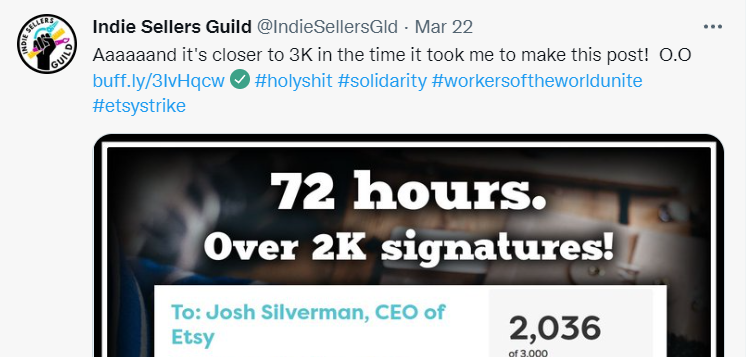
March 23, 2022
Buzzfeed Article

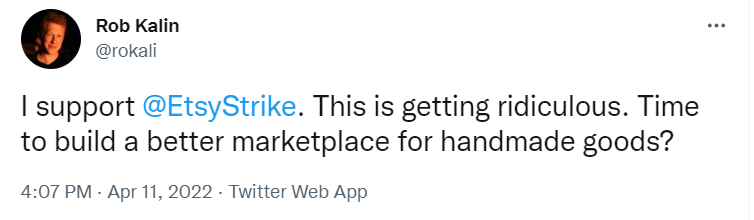
April 11, 2022
Rob Kalin Speaks Out
Etsy’s original CEO and founder, Rob Kalin, broke a 7.5 year Twitter silence to tweet in support of striking sellers!
April 12, 2022
Josh Silverman Speaks Out
The next day, Etsy’s current CEO also had something to say:

April 13, 2022
25K Etsy Sellers
On this day, the number of people that signed the petition and checked “I’m a seller” passed 25 thousand.

April 18, 2022
The Strike Ends
Our petition had 82K signatures, but still no response from Etsy. We started a snail mail campaign. We invited the ~29K sellers who had signed our petition to print a PDF of our letter and mail it to Etsy, and do so as creatively as possible.

April 26, 2022
Etsy CEO Compensation
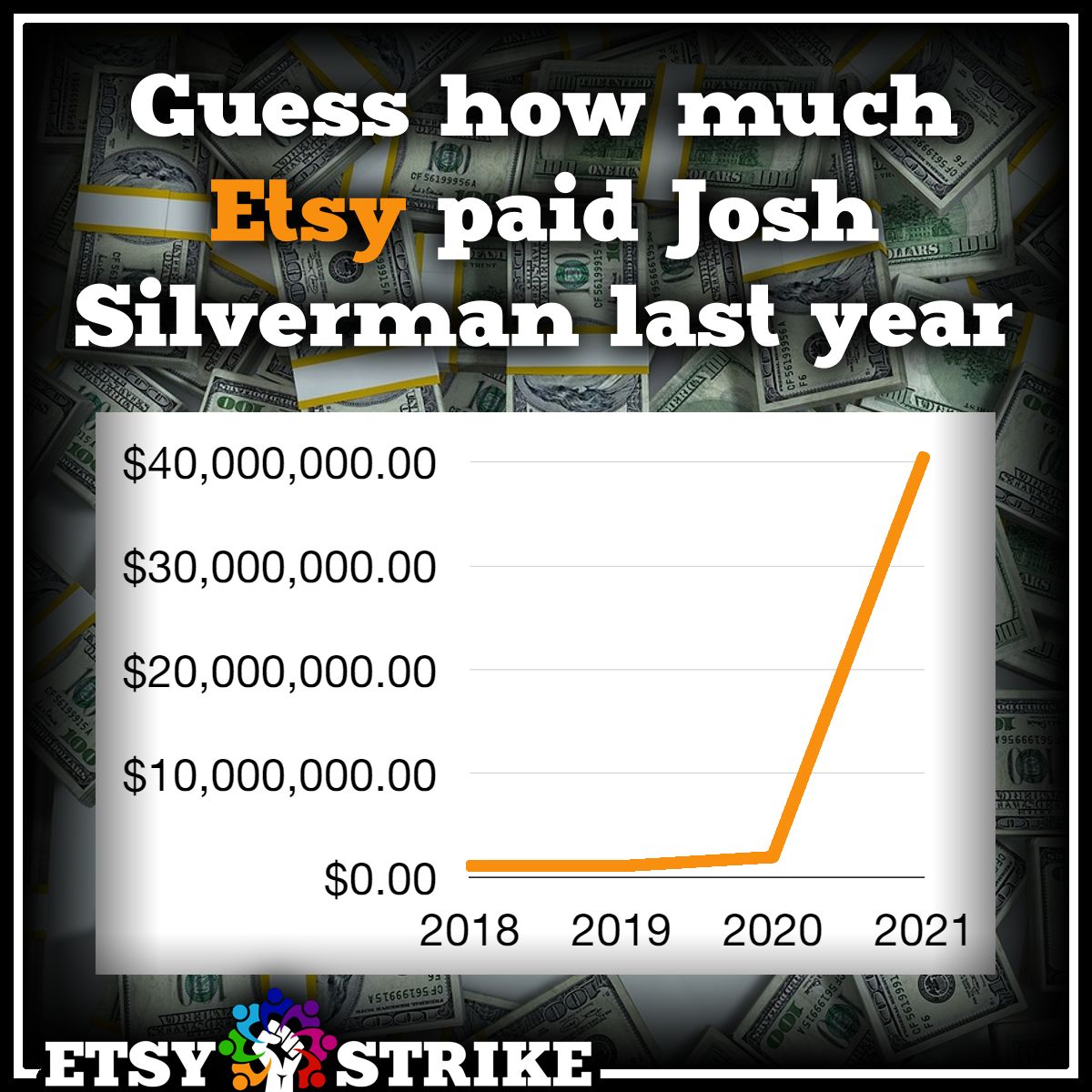
The news came out that Etsy’s CEO, Josh Silverman, had been paid 40 million dollars the previous year.